
The Beaker Burial
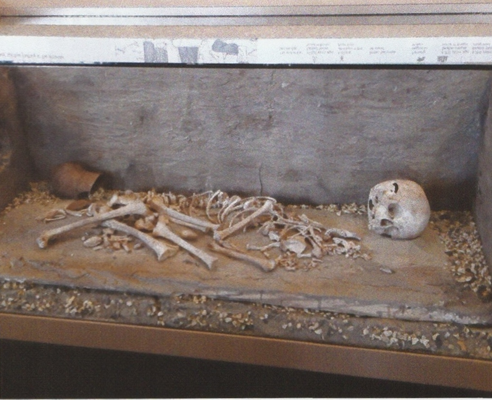
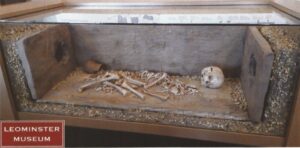 For a typical young person, particularly a boy, the Beaker child skeleton in the museum is one of our most exciting exhibits. We adults have a ghoulish interest in this sort of thing too. There is something about old bones which fascinates all of us (obviously with the exception of the teenager whose default ennui allows for no interest in anything) and we all know why. We all have a skeleton but none of us will ever see our own — they are evidence of the death of the person to whom they belonged and we are all fascinated by death – the only thing that is certain in life apart from taxes according to Christopher Bullock in his 1716 afterpiece, a one act play The Cobbler of Preston. The first recorded mention of what has become a truism.
The skeleton in the museum was found by a digger driver at a gravel pit at Aymestrey in 1987. Archaeologists were called to the scene which I suspect was very frustrating for the company working the gravel but even the managers of the business must have been interested and understood what a find it was.
Beaker People, who to start with were a culture rather than a tribe or race, came from the continent and gradually spread into Britain, replacing Stone Age people but with no obvious evidence of conflict. Their graves are widely scattered across Herefordshire.
The grave which the digger broke into was made of a few, flat, Much Wenlock limestone slabs which would have had to be shaped for the purpose, it contained the remains of a seven or eight year old child whose sex cannot be determined.
The child with a beaker (the grave good which the people who buried the child are named after) and a flint knife. The beaker and flint knife are in the exhibit too. The child lived somewhere between 4,000 to 3,300 years ago in the early Bronze Age. There is no way of knowing why the child died, the skeleton gives no clues.
We can only imagine the anguish that the child’s parents suffered as there can be no doubt that in every way apart from their less sophisticated technology they were exactly like us and must have grieved terribly.
Despite our shared interest in the macabre, our adult visitors understand this and most stand quietly still when looking at the exhibit while they wonder how the Beaker People lived and died. The Francis Crick Institute (named after
the British half of the two scientists who discovered DNA), which employs more than 1,500 biomedical scientists, wanted to take a sample to analyse from our Beaker child a while ago, but our curator, who was as keen to find out more about the skeleton as the institute, discovered that the cabinet in which it is displayed cannot be opened. So any other possible discoveries about the child’s existence may forever remain a mystery.
Marcus Williams
This article was originally published in the May/June 2026 edition of Leominster News.