Walenty Pytel, 1941–Present
Sculptor
Walenty Pytel was born in Poland and fled to Britain during the Second World War.
He lived for a time at the Barons Cross Camp in Leominster and studied graphic design at Hereford College of Arts.
He is recognised as a leading metal sculptor of birds and animals.
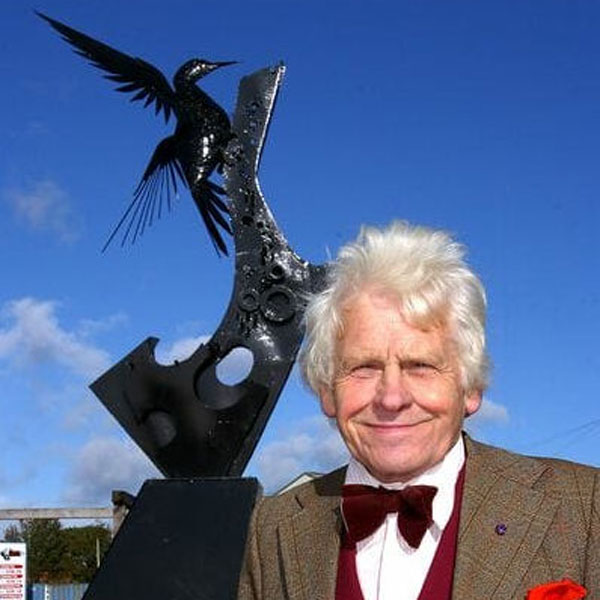
Walenty Pytel was born in German-occupied Poland during the Second World War. Because of his blond features, the Nazi authorities kidnapped him from his mother to be adopted by a Gestapo officer and his childless wife. However his mother, Jadwiga Pytel, escaped from a prison camp and snatched him from outside the couple’s home. They fled from Poland to Italy, and eventually came to Britain in 1946.
Pytel lived for a time at the Barons Cross Camp in Leominster. He later studied graphic design at Hereford College of Arts and opened two studios in Hereford in 1963, initially focusing on paper sculptures for window displays.
He turned to sculpting in metal in 1965 and received his first public commission from Hereford City Council who commissioned Walenty to make aluminium stars to hang in the town. He also made three large angels mounted on a triangle as the centrepiece in High Town.
His creations are often inspired by nature. In 1969 he created the Woodpecker statue for the Bulmers site on Whitecross Road, Hereford. The Woodpecker statue together with ‘Kingfisher with Minnow’ are now outside the Cider Museum, Hereford.
To mark the Silver Jubilee of Her Majesty Queen Elizabeth II in 1977 Pytel was commissioned by Members of Parliament to create the Jubilee Fountain which now stands near the foot of Big Ben near the Houses of Parliament.
The Fossor, (the Latin for “digger”) is at the entrance to the JCB plant at Rochester. Made entirely of digger parts, it weighs 36 tonnes, stands 45 feet high and was the largest steel sculpture in Europe at the time of its creation in 1979. In 1985 he completed Take Off for the approach to Birmingham Airport. The unpolished steel sculpture of three egrets was designed to commemorate forty years of peace in Europe.
Pytel has created a number of sculptures in the Borders, including two prominently displayed on the banks of the River Wye at Ross-on-Wye, where he now lives. In 2001 he made a sculpture of a magpie for the village of Weobley commissioned after the village won the Village of the Year in 1999. He was commissioned by the local branch of Royal British Legion to create Ludlow’s first out-of-church public war memorial. It was unveiled in 2000.
In December 2008 he designed a sculpture for the Royal National College for the Blind in Hereford which he would create using an original drawing produced by a student at the college. The piece, depicting a man running in the Futurist style and titled the 4Runner was completed in 2009
An exhibition of Pytel’s work, Sparks to Life, was held at Nature in Art, Gloucester, in 2020.
In 2023 Catherine Gilling and Jason Hodges published Walenty Pytel | Life | Art | Sculpture. The only authorised biography of this enigmatic artist.
These notes are based on Walenty Pytel’s entry in Wikipedia and correspondence with Mary Pytel.